Before I Had the Words
What Vessel Reveals About the Limits of Communication
What if the reason you love a song has nothing to do with what the artist is trying to tell you?
It's a strange question to ask about an album I've spent more than a decade listening to, especially one whose lyrics I practically memorized at 12. But the more I revisit Twenty One Pilots' Vessel, the more convinced I become that I originally misunderstood what made it so extraordinary to me. Not because I failed to recognize its themes of depression, isolation, faith, and perseverance, but because I assumed the words were responsible for a connection that may have started somewhere else entirely. I used to think I loved Vessel because it gave me language for experiences I couldn't explain. Now I wonder whether I loved it because, for the first time, I was hearing music that seemed to organize itself the way my own thoughts did. And that's a much more interesting possibility, because it suggests that sometimes the most meaningful part of communication isn't what someone says. It's how the expression itself makes sense to the person experiencing it.
Released in 2013, Vessel sounds like a band refusing to choose between every idea it has ever had. Tyler Joseph jumps from frantic rap verses to bright, enormous choruses, while Josh Dun's drums keep the songs moving through electronic pulses, piano melodies, and the occasional stylistic detour that seems to arrive from another album entirely. The lyrics contemplate loneliness, despair, faith, and survival. The music frequently makes you want to jump around your room. It's a combination that really shouldn't work this well. Sometimes it doesn't. But at its best, Vessel pulls off something more interesting than putting cheerful sounds behind sad words: it gives difficult emotions a shape listeners can inhabit, and sometimes even enjoy inhabiting. Its weaker moments reveal the risk of the same approach. An unexpected turn is exciting only until it stops taking you somewhere.
I first listened to Vessel when I was 12, before I knew I was twice-exceptional (2e). I could lose hours exploring complicated ideas just because I was curious, then struggle to complete an ordinary school assignment. I didn't understand why, and I certainly wasn't analyzing the relationship between musical form and my neurodivergent experience. I heard songs that changed direction as abruptly as my thoughts did, and I loved them. I still do. Except now I've noticed something I couldn't have articulated then: when I scream along to "Car Radio," I'm not necessarily reliving anything painful. I'm genuinely, ridiculously happy. The lyrics haven't changed. What is the music doing that makes expressing them feel so different from what they describe?
Catherine Yi (2013), writing for idobi, praises the band's mixture of styles and the confidence of its experimentation. Tyler White (2018), reviewing the record for Sputnikmusic, emphasizes how the clearer production and tighter instrumental performances elevate songs that had appeared in earlier versions. Both are right about what makes Vessel distinctive, although I wouldn't give the band full credit simply for sounding different or more polished. The better test is whether its choices change the experience of listening. Does a chorus release something a verse has been holding back? Does repetition create anticipation or just consume another thirty seconds? The album provides unusually good examples of both.
Start with "Ode to Sleep," a five-minute introduction that seems almost delighted to be difficult to categorize. Its darker electronic passages and breathless rapping are interrupted by melodic, almost sunny choruses, with piano and synthesizer lines pulling the song between moods. The transitions can be clumsy, and Joseph occasionally crams so many syllables into a phrase that the delivery sounds crowded rather than agile. Yet the contrast becomes the song's personality. By the second shift, you're not waiting for the band to settle into one style; you're listening for the next surprise. What initially sounds like several competing songs gradually becomes one recognizable composition. I love that its identity comes from its changes, not from pretending those changes aren't happening.
Dun has a lot to do with why that works. Joseph's voice is the obvious attention-grabber, but the drumming gives those competing sections momentum and something like a shared pulse. On "Holding On to You," the rhythmic push helps the rap passages and soaring hook feel like parts of the same argument, while "Guns for Hands" folds a playful rhythmic detour into a song with far darker concerns. Not every genre change is subtle, nor does it need to be. Still, the best transitions have a musical purpose beyond showing that Twenty One Pilots can play another style. White's (2018) attention to the cleaner recordings is useful here: you can hear the parts distinctly enough to notice how they're working together, including the moments when they aren't.
What initially sounds like several competing songs gradually becomes one recognizable composition.
ON "ODE TO SLEEP"Car Radio
THE SOUND OF HAVING NOTHING TO LISTEN TO.

"Car Radio" is the album's clearest answer to what all that movement can accomplish. I love that Joseph somehow turns a stolen car stereo into a discussion about human consciousness. "Sometimes quiet is violent," he observes, treating silence as something threatening rather than peaceful (Twenty One Pilots, 2013, track 5). The theft removes more than a source of entertainment. It leaves him alone with thoughts he was using the radio to keep at a distance. We tend to talk about media as though it's always distracting us from paying attention, but this song complicates that neat opposition. What if something we call a distraction is sometimes what helps a person manage attention in the first place? From my own neurodivergent perspective, that's an interesting possibility, not a claim about Joseph's intentions or every listener's experience.
The arrangement makes that question feel urgent without immediately telling us to feel urgent. Joseph begins almost conversationally over sparse accompaniment, letting one thought lead to the next. The missing radio keeps bringing him back to the same ordinary problem even as his thoughts grow increasingly frightening. Then the track starts tightening around him. The beat takes on more weight, the electronic textures occupy more space, and Dun's drumming pushes the music forward until Joseph abandons his measured delivery for a shout. By that point, the climax doesn't feel like an arbitrary volume increase. We've spent the whole song hearing him try to talk his way through something that no longer seems containable in a carefully worded verse.
Yi (2013) calls "Car Radio" the album's most intriguing track and describes its music expanding with the story. She's right, although I think the arrangement deserves more than a supporting role to the lyrics. At the beginning, we receive an explanation. By the end, we have something we can physically join. Would another brilliantly written verse communicate more than the screaming does? It might supply more information, but that's not quite the same achievement. There's also something wonderfully ridiculous about a song whose narrator desperately misses his radio becoming a song listeners deliberately put on theirs. The recording becomes the thing he lost. For me, its final release isn't a reenactment of his distress. It's the exhilarating experience the music has built out of it.

"Migraine" is just as revealing because it goes about the problem backward. Where "Car Radio" grows from an everyday inconvenience into an overwhelming thought process, "Migraine" opens inside a mind that's already crowded. Joseph fills the lyrics with threatening landscapes and elaborate mental images, yet delivers them in carefully packed rhymes against a persistent rhythmic framework. The contrast is almost funny in its precision: he's describing thoughts that seem impossible to control while demonstrating an impressive ability to arrange them. The verse doesn't sound effortless, and that's part of its appeal. You can hear how much concentration it takes to make all those words land where they do.
Then the chorus arrives and suddenly listening requires much less effort. The melody opens up, the phrase becomes easier to hold onto, and a listener who couldn't follow every image can still sing the song. Joseph's line "my writer just hates the clock" catches my attention for a related reason (Twenty One Pilots, 2013, track 3). Having a thought and producing an explanation under somebody else's conditions aren't necessarily the same ability. That's a distinction I recognized long before I had language for being twice-exceptional. But I wouldn't turn "Migraine" into a song about neurodivergence to make the comparison fit. As Adam R. Holz (n.d.) emphasizes in his Plugged In review, Vessel engages seriously with despair, faith, and perseverance, and the song's suicidal imagery isn't interchangeable with my own experience. The musical achievement is broader: the densely ordered verse and accessible chorus allow listeners to encounter that distress in more than one way.
"The Run and Go" manages a related trick with considerably less effort, at least on the surface. Its playful piano figure, easy percussion, and cheerfully wordless refrain feel almost too simple after the verbal acrobatics of "Migraine." But the lyrics describe a narrator who wants someone nearby without having to explain everything he's carrying. "Don't wanna give you all my pieces," Joseph sings (Twenty One Pilots, 2013, track 8). That line could sit inside a much heavier song, and maybe that's why the almost childlike singalong works. He struggles to share something private; the arrangement creates something listeners can share immediately. You don't have to know the words, understand his circumstances, or agree on what the song means. You just know when to join in.
It's tempting to call that connection, but I think the more interesting word is participation. Thousands of listeners can sing the same refrain and still be experiencing different things. A recording doesn't have to produce identical feelings to become something people share. Yi (2013) appreciates the track's playful simplicity, and I do too. Unlike some of Vessel's more elaborate moments, "The Run and Go" knows exactly how much musical information it needs. That doesn't make it less ambitious. It means the band understands what the refrain is supposed to accomplish.
"Fake You Out" is messier, and it benefits from being messier. Joseph questions how close another person can really be, wondering whether "close" is a useful description when the distance between people may look different from each side. The comparison to a nearby star is strange enough to make me stop every time I hear it: close to what, exactly? The arrangement keeps shifting its own perspective. Joseph moves from restrained singing to an urgent, forceful hook and then into a rap passage that makes the earlier vulnerability sound almost defensive in retrospect. He's not merely cycling through styles. Each delivery changes how we hear the person speaking.
I recognize something in that instability. Growing up, I could be expressive in one environment and almost silent in another, and people could draw completely different conclusions about who I was. But the point isn't that Joseph has written a secret account of my experience. It's that the vocal performances are convincing without one having to be the authentic one and the others disguises. The song's contrasts make the emotional tension audible. And unlike a gratuitous genre switch, this one gives the listener a reason to hear the preceding section differently.
Of course, this is also where the album's confidence can turn into a weakness. "Semi-Automatic" has a terrific, buoyant electronic hook set against a much darker self-description. I enjoy it every time. I'm just not convinced the arrangement does much with that contradiction once we've heard it. The familiar synth pattern keeps circling, and the repeated hook holds the same tension rather than making it more complicated or releasing it. "Screen" fares a little better at first. Its softer opening, piano and ukulele textures, and tentative vocal delivery create a welcome feeling of closeness. But the communal refrain eventually seems satisfied with being easy to sing. Enjoyable? Absolutely. As revealing on the fifth return as on the first? Not really.
That criticism isn't an argument against simplicity, or even repetition. "The Run and Go" is simple, and it's one of the album's most effective songs. "Trees" repeats itself relentlessly, but there the changing arrangement gives each return a new sense of scale. The steady build encourages anticipation; as more intensity gathers around the same phrases, you're listening not just to what repeats but to what's different this time. "Semi-Automatic" and "Screen" offer the pleasure of recognition without that same feeling of arrival. Neither needs another genre change to improve. They need a stronger reason to keep doing what they're already doing.
The art of stopping.
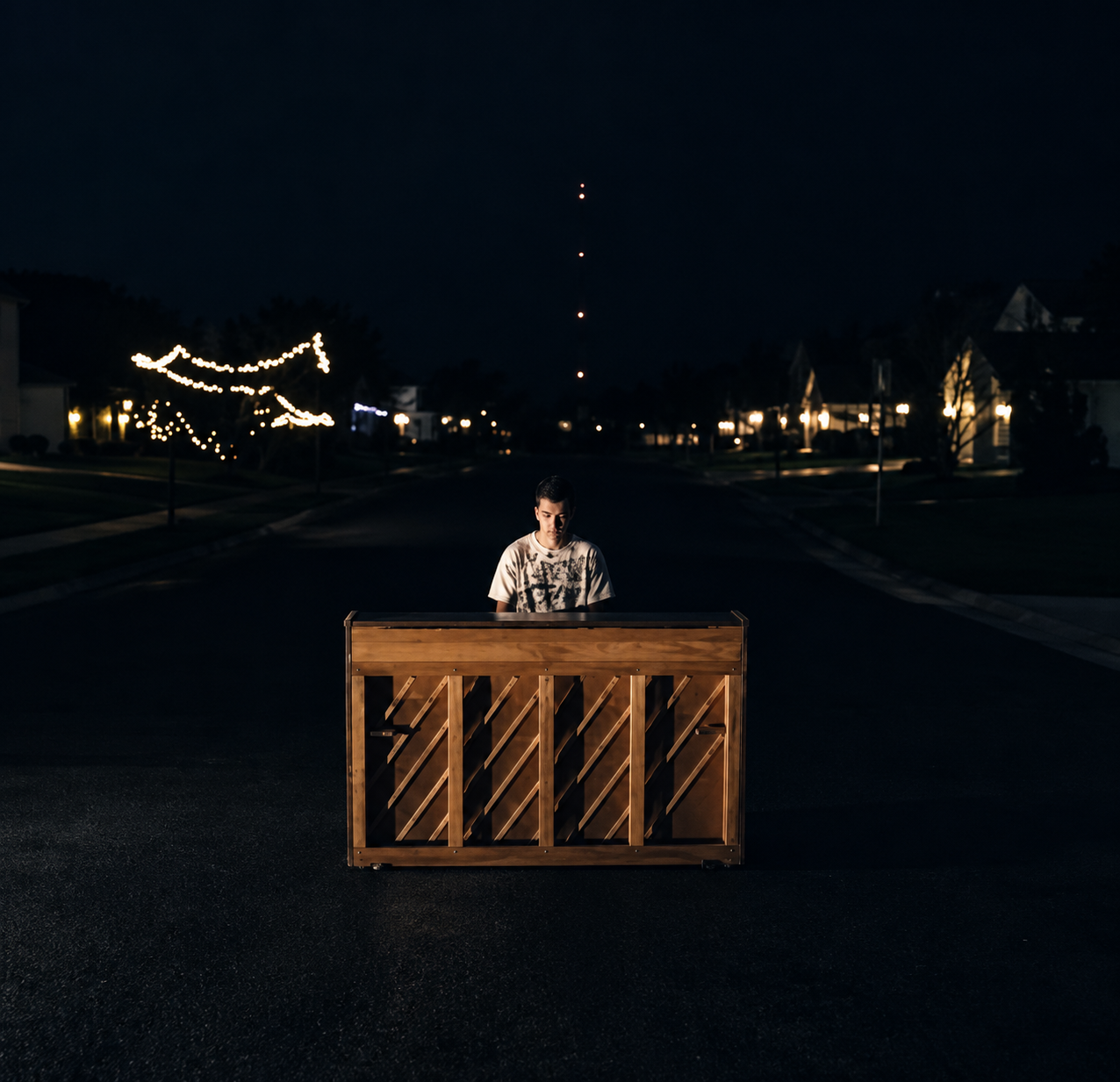
The sequencing makes that distinction especially clear near the end. "Trees" takes its time gathering momentum, then "Truce" follows with little more than Joseph's voice and piano. After an album full of crowded verses, sudden turns, and maximal choruses, the restraint is almost startling. The encouragement to "stay alive" lands without another complicated metaphor or dramatic production trick (Twenty One Pilots, 2013, track 12). In fact, it's more effective because there isn't one. Maybe my favorite surprise on a record that's constantly surprising us is that it knows how to stop. The final track doesn't attempt to outdo the one before it. It lets the earlier noise make the quiet count.
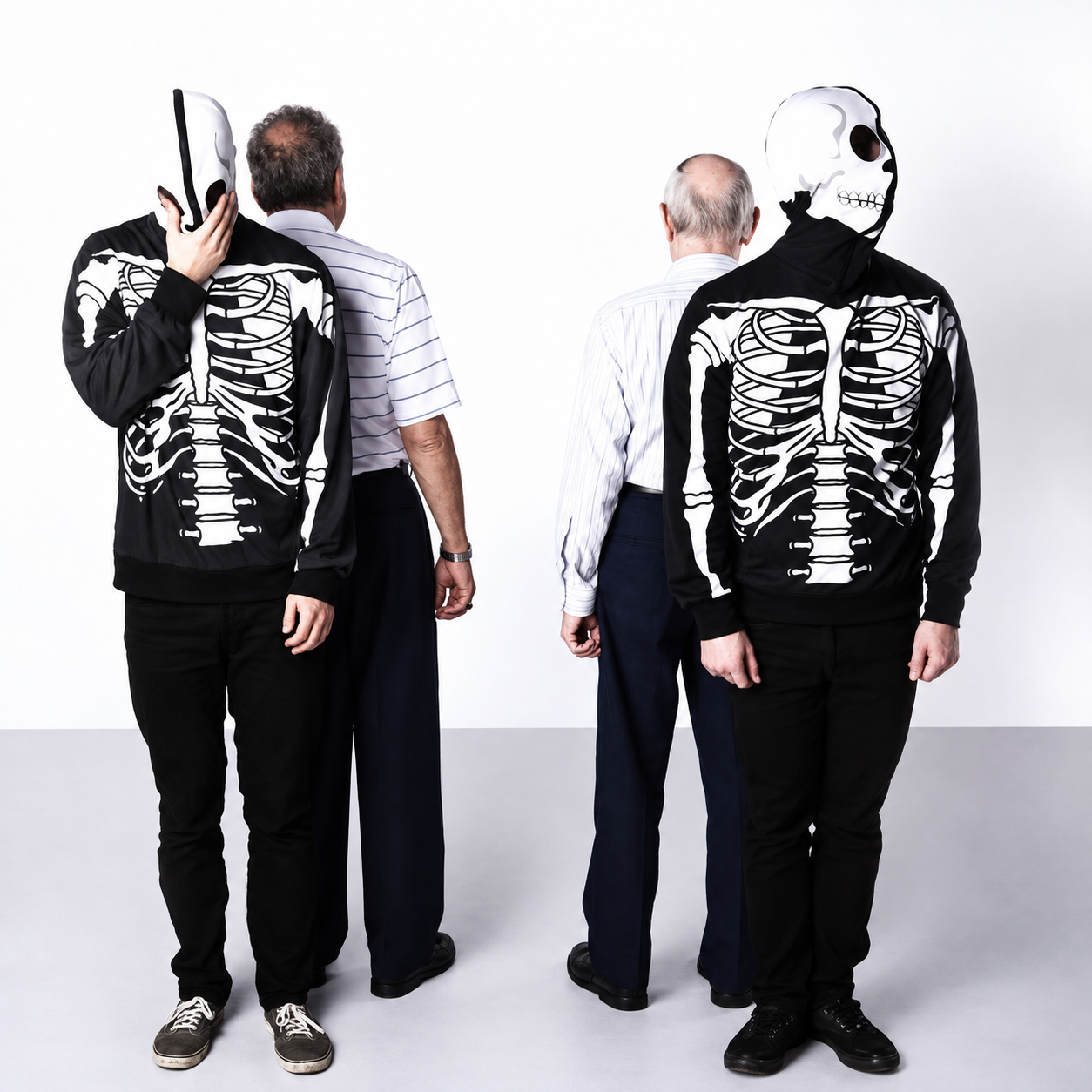
Even the cover art seems better suited to the album after hearing that ending. The front features Joseph's and Dun's paternal grandfathers, an almost aggressively ordinary photograph for a record this restless. On the back, the musicians stand behind them in skeleton suits. It's an absurd image, and I love that the younger men are the ones dressed as skeletons. But it also offers a neat complication of the title Vessel: seeing what's beneath a person's clothes doesn't tell us what it's like to be that person. The songs can't deliver another person's inner life intact, either. They can give it a form that travels, something another listener can hear and do something with. What arrives may not be exactly what left.

So no, Vessel isn't flawless. Joseph sometimes confuses urgency with fitting more words into a verse, and a couple of the hooks wear out their welcome. But the strongest arrangements justify the band's refusal to stay in one musical lane. "Ode to Sleep" makes its inconsistency recognizable. "Car Radio" builds a release the lyrics alone could never supply. "Migraine" turns crowded imagery into disciplined rhythm; "The Run and Go" makes an uncomplicated refrain carry a complicated desire; and "Fake You Out" finds different emotional meanings in Joseph's changing voice. The best songs don't succeed because they're busy, surprising, or heartfelt. They succeed because every contrast gives us something to hear that wasn't there a moment earlier.
And this is where I come back to being 12. I couldn't explain why I felt so alone or why ordinary things sometimes seemed impossibly difficult. I didn't need to understand every lyric in order to know every word. When "Car Radio," "Migraine," "Fake You Out," or "The Run and Go" played, I could shout something painful and feel an almost euphoric freedom. Not relief first, then happiness. Both at once. That's still what happens now. I'm not listening to revisit the hurt, and I'm certainly not claiming to know what Joseph felt when he wrote these songs. I'm responding to what he and Dun made possible in the recording.
I used to describe Vessel as music that gave me words when I didn't have them. That was true, but incomplete. Plenty of songs can describe a painful experience accurately; far fewer can turn the act of expressing it into something you genuinely look forward to. Vessel manages that often enough, and with enough musical imagination, that its awkwardness rarely outweighs its achievement. Maybe it wasn't the soundtrack to my pain. Maybe it was the first place that pain could become something other than pain. Not because the album fixed anything, or because I understood myself at 12, but because a song gave me a way to participate in something I couldn't yet explain.
- Holz, A. R. (n.d.). Vessel. Plugged In. https://www.pluggedin.com/album-reviews/twenty-one-pilots-vessel/
- Twenty One Pilots. (2013). Vessel [Album]. Fueled by Ramen.
- White, T. (2018, September 30). Twenty One Pilots | Vessel. Sputnikmusic. https://www.sputnikmusic.com/review/78050/Twenty-One-Pilots-Vessel/
- Yi, C. (2013, January 8). Vessel: Album review. idobi. https://idobi.com/music-reviews/album-review-twenty-one-pilots-vessel/